 BATTLYTICS.GG
Checking access…
Battlytics.GG © 2026. All Rights Reserved.
BATTLYTICS.GGChecking access…
Battlytics.GG © 2026. All Rights Reserved.
Riot's first paper TCG throws out the genre's oldest rule. You don't grind an opponent's life to zero — you take ground and keep it. Send your champion and an army to seize battlefields, hold them through a turn, and race to eight points. This guide assumes you already know your Aatrox from your Azir; it doesn't assume you know a chain from a showdown. Pick a tab and go.
Forget life totals. In Riftbound, the map is the game. There are battlefields in the middle of the table, and the whole match is a fight to occupy them. The currency of victory is points, and points come from territory.
| The objective | Reach 8 points before your opponent (11 in a 2v2). Every game — Duel, 3-player, 4-player — is a race to that number. |
| Conquer | Win a fight at a battlefield so that only your units remain there. +1 point, once per battlefield per turn. |
| Hold | Still controlling a battlefield, uncontested, when your next turn begins. +1 point per battlefield held, every turn, for free. |
| The squad | One Legend (your leader, off to the side all game) + one Champion unit you can deploy whenever + an army of units, spells, and gear. |
That Conquer-then-Hold loop is the engine of the entire game. Take a battlefield this turn for a point; if you can keep it, it prints another point at the start of every future turn. Your opponent is forced to come dislodge you — which means you decide where the fights happen.
Every card belongs to one or more of six domains — Riftbound's colors. Your Legend declares which domains your deck may use (Origins Legends have two). Domains aren't just flavor; each has a mechanical personality. Tap any to expand.
Each player has their own home area (the Base) and decks, while the battlefields sit in shared no-man's-land between players. Click a zone to learn its job.
The board is split into your private home rows and the shared battlefields you're both fighting over. Each zone has exactly one job — select any cell to read it.
| Legend | Your leader. Sits in the Legend Zone all game (it never enters play as a unit), defines your domains, and usually has a passive or activated ability that powers the whole deck. |
| Champion unit | Your Chosen Champion — a signature unit that starts face-up in the Champion Zone and can be played at any legal moment, like it's always in your hand. Once played it's a normal unit (and if killed, it goes to the Trash). |
| Unit | Your fighters. They have Might (top-right) = both the damage they deal and the damage they can take. They move between your Base and battlefields, and they're how you contest ground. |
| Spell | One-shot effects that resolve and go to the Trash. Action spells can also be played during showdowns; Reaction spells can interrupt mid-chain on anyone's turn. |
| Gear | Permanents that stay in your Base and grant passive or activated abilities. Seals are a common gear that bank Power for you. |
| Rune | Lives in a separate 12-card Rune Deck, not your main deck. Runes are your entire economy — covered next. |
Before any strategy, you need to parse a card at a glance. Read in this order — cost, type and tags, keywords, rules text, then Might — and you'll instantly know when a card can be played and what it's for. Tap a number on the card to break down each part.
Sitting down to a Duel takes about a minute to set up. The sequence:
This is the system that makes Riftbound click, and it's the one thing that trips up every newcomer. There is no single "mana." Instead, your Runes produce two resources, and you choose which one each Rune makes — by choosing how you use it.
| Energy colorless | Exhaust a Rune (turn it sideways) → +1 Energy. Any Rune of any domain makes Energy. Pays the numeric cost in a card's top-left. |
| Power colored | Recycle a Rune (put it on the bottom of your Rune Deck) → +1 Power of that Rune's domain. Pays the colored pips. A Fury pip needs a recycled Fury Rune — no substitutes. |
The catch that makes it elegant: exhausting is temporary (the Rune readies again next turn), but recycling literally removes the Rune from your board and shuffles it to the bottom. Spend too much Power early and you'll be rune-starved later. Both resources sit in a temporary Rune Pool that empties at the end of your draw phase and again at end of turn — nothing carries over.
Try it. Below is a card with a cost. Use the Runes on your board to pay it: exhaust for Energy, recycle for Power. Cycle the card to see different cost shapes.
Every turn runs the same rigid sequence. The first four phases have a mnemonic — A·B·C·D — and they're mostly automatic. The real game happens in the Action Phase. Step through it:
You score Holds at the start of your turn, not the end. Points from holding land in the Scoring Step of your Beginning Phase — so a battlefield you took last turn and kept pays out the moment your next turn begins. Your Champion is always available. It's not stuck in your deck; it waits in the Champion Zone and can drop at any legal window, so hold it for the moment it flips a fight.
Theory lands once you see it run. Here's a clean opening with a Jinx-style aggro deck, on the play, against an opponent who isn't contesting yet.
You'd think reaching 8 points is just arithmetic. It mostly is — except for the Final Point rule, which has decided more games than any card. Drive the simulator: move units onto battlefields, end turns, and watch how points actually accrue.
| The Final Point rule | If your 8th point would come from Conquering, you must have conquered both battlefields that same turn — otherwise you just draw a card instead of winning. |
| Holding closes it out | If your 8th point comes from a Hold, you win even from a single battlefield. Patient decks love this. |
| Cards can override | An ability that directly grants a point (e.g. "when you hold, score 1") can be your Final Point regardless of the above. |
Moving a unit into a contested battlefield opens a Showdown — Riftbound's combat window. The attacker gets first say, both players trade Action/Reaction spells, and when everyone passes, Combat resolves. The math is blunt: each side deals damage equal to the total Might of its units, simultaneously. A unit dies if it's assigned damage equal to or above its Might.
You take ground by moving units. A Standard Move costs nothing but exhausting the unit — turn it sideways and send it. By default units move only between your Base and a battlefield (the keyword Ganking lets a unit slip battlefield-to-battlefield instead). You can move several units at once by exhausting each, and you can move a unit back to Base too. Units enter play exhausted, so they usually can't move the turn you play them — unless they have Accelerate, or they're Gear (which enters Ready).
But three keywords bend the Might math, and they're where combat skill lives. Build a fight below — set Might on each side, toggle keywords, and read the outcome.
| Only attackers survive | Conquer. You take the battlefield and score a point. Your champion-style "on conquer" triggers fire. |
| Only defenders survive | Attack repelled. The defender keeps control and scores nothing this exchange. |
| Both sides survive | No conquer. Your surviving attackers are Recalled to your Base for free (not a "move," can't be stopped), and the defender keeps the battlefield. |
| Nobody survives | Battlefield empties out, uncontrolled. No one scores. Common when raw Might trades evenly. |
Whenever a spell or activated ability is played, it goes on the Chain and the game enters a Closed state — only Reaction cards may respond. The Chain resolves last-in, first-out, like a stack of plates: the most recent play resolves first. This is how a counterspell beats the spell it answers.
| Open vs Closed | No chain = Open, you can do anything. Chain exists = Closed, only Reactions. Resolving the chain reopens the state. |
| Priority vs Focus | Outside combat, the right to act is Priority. Inside a showdown it's Focus — same idea, but it starts with the attacker and restricts you to Action/Reaction plays. |
| Action vs Reaction | Action widens when you can play (also during showdowns). Reaction goes further — it interrupts an open chain on anyone's turn. Reaction includes everything Action does. |
A worked example of why order matters: you attack with a 3-Might unit and play a spell to give it +3, aiming for a 6-Might swing. Your opponent responds with Gust as a Reaction — a spell that can only hit units with 3 or less Might. Because the Reaction resolves first, it checks your unit while it's still 3 Might, bounces it back to your hand, and your buff spell fizzles with no target. Same two cards, opposite outcome, decided entirely by the LIFO order.
Riftbound's cards are written in plain English, but a set of keywords does the heavy lifting. These are the ones you'll meet constantly. Tap any to read the rule, plus a worked example.
Once the basics are automatic, matches are decided in the corners of the rulebook. A few that pay rent:
There's no separate "deck-out loss." If you try to draw, reveal, or trash from an empty Main Deck, you Burn Out: shuffle your Trash back into your deck, give an opponent a point, then complete the draw. Decks that churn cards hard (hello, Jinx) are quietly racing their own library — every "draw 2" is a future point you might be handing over.
After every chain, move, showdown, and combat, the game runs a Cleanup: units with lethal damage die, attacker/defender labels clear, orphaned Hidden cards are removed, "while/as long as" effects re-check, and pending combats get staged. Smart players time a spell or move specifically to trigger a Cleanup that kills a wounded enemy or flips control of a battlefield.
Rather than play a Hidden card, recycle a Rune to tuck it facedown at a battlefield you control. Next turn it gains Reaction and you can flip it for free. It's a loaded trap: your opponent has to play around a card they can't see, exactly like respecting an un-warded bush. But Hiding isn't "playing," so it won't turn on Legion or on-play triggers — and if you lose the battlefield first, the hidden card is trashed.
Deflect [X] taxes opposing targeted removal by X extra Power — protect your engine and their cheap kill spell suddenly can't be afforded. Tank reorders how lethal must be assigned: the attacker has to fully kill your Tank before touching anything behind it, which is how a 2-Might throwaway can soak a 6-Might swing and save your carry. Stack Tank with Shield and a trade becomes a brick wall.
| Main Deck | Exactly 40 cards, including your Chosen Champion. Max 3 copies of any single card. Every card must match your Legend's domains. |
| Rune Deck | Exactly 12 Runes, in your Legend's domains. Your color balance here decides whether you can pay your Power costs on time. |
| Battlefields | You bring 3, and they're colorless so any are legal. They're a real deckbuilding lever — each has a passive that should reward your gameplan. |
| The "56-card" box | A retail Champion Deck advertises 56 cards: that's 40 main + 12 Runes + 3 battlefields + 1 Legend. The math reconciles. |
| Duel (Bo1) | Each player randomly reveals one of their three battlefields, and you play. The standard quick game. |
| Match (Bo3) | You choose which battlefield to bring each game, but can't reuse one across the match — so your three battlefields are a small sideboard of their own. |
| Teams (2v2) | Race to 11. Partners can't bring the same battlefield, keeping the map varied. |
| Organized play | Riot runs City Challenges → Regional Qualifiers → Regional Championships. A live ban list keeps the format honest (cards like Dazzling Aurora have drawn community ban-watch). |
| Origins OGN | The launch set (Oct 2025, ~298 cards). Home of the Jinx, Lee Sin, and Viktor Champion Decks. A Proving Grounds starter (OGS) accompanied it. |
| Spiritforged SFD | Second set (Feb 2026, ~221 cards). Introduced the "winning a combat" rules and new keywords. |
| Unleashed UNL | Third set (May 2026, ~219 cards). Home of the Vi and Vex Champion Decks, and the Predict action. |
| Vendetta | Next on the roadmap (mid-2026, 160+ cards). |
Two card classes worth knowing for deckbuilding: Signature cards (spells or units tied to a specific champion, like Annie's Tibbers) are capped at 3 per champion tag and — importantly — a Signature unit can't be your Chosen Champion even if it shares the name. And tokens (Sprites, Gold, Mech, double-faced Buff/XP tokens) are created by cards during play; they behave like units or resources but live outside your 40.
The two decks studied in the next tabs come from Origins (Jinx) and Unleashed (Vex) — a near-perfect pair of opposites to learn the game on.
The reference half of the guide. Every set from Origins to Unleashed, how the card pool has grown, and the rules scaffolding underneath it — the layers a turn passes through, the Core Rules, and the Tournament Rules that govern competitive play. Come here when you need the exact wording, not the vibe.
"Origins," "Spiritforged," and "Unleashed" are card sets. "Core Rules" and "Tournament Rules" are rules documents. People lump them together, but they answer different questions: a set tells you what cards exist; the Core Rules tell you how the game works; the Tournament Rules tell you how sanctioned events run. Tap each layer to see what it actually governs.
Sets are cumulative and mix freely — owning cards from three sets just means a bigger pool to build from. Each set ships new cards and a Core Rules update that refines how things work. Here's what each one brought.
The Core Rules get a patch with each set, and between patches Riot publishes FAQ and errata documents. Two things worth understanding:
| FAQ & clarifications | Explain how a confusing card or interaction is meant to work. They take effect immediately and get folded into the next Core Rules update. |
| Errata | Actual changes to a card's printed text, to make it work as intended. The card in your hand may read slightly differently from how it's now played. Riot says errata are issued to fix function, not to nerf for power level. |
| Card shorthand | Newer cards and docs use symbols: [E] exhaust, [M] Might, [A] one power of any domain, [C] one power of this card's domain. |
Practical version: if a specific card you own ever seems to behave strangely, the latest FAQ for its set almost certainly has the answer — and that answer wins over the older printed wording.
The Tournament Rules are a separate document covering sanctioned play. They define the formats and add procedures that simply don't exist at a kitchen table:
| Duel | 1v1, best-of-one, two random battlefields. The default casual game. |
| Match | 1v1, best-of-three; each game you each choose a battlefield, no repeats across the set. |
| Multiplayer | Skirmish (3-player free-for-all), War (4-player free-for-all), and 2v2 (first to 11). Built-in, but not your focus. |
| Event procedures | Deck registration, time limits, a banned-card list, and judge rulings. All of this is TR-only. |
Cutting through all of it, here's the entire surface area that affects two people playing 1v1 at home:
Riftbound's control deck — you don't race, you outlast. A Calm/Chaos shell that holds ground, draws ahead off every uncontested battlefield, answers each threat, and lets the opponent run out of cards and patience first. Patience isn't passive here: holding is your draw engine.
"I'll show them the meaning of apathy. Or not." Vex is the Shadow Isles' resident teen nihilist, and her deck plays exactly how she'd want it to: it refuses to be excited, refuses to be rushed, and slowly makes the game miserable for everyone else. This is Riftbound's control deck — you don't race, you outlast. Hold ground, draw ahead, answer every threat, and let the opponent run out of cards and patience before you run out of either.
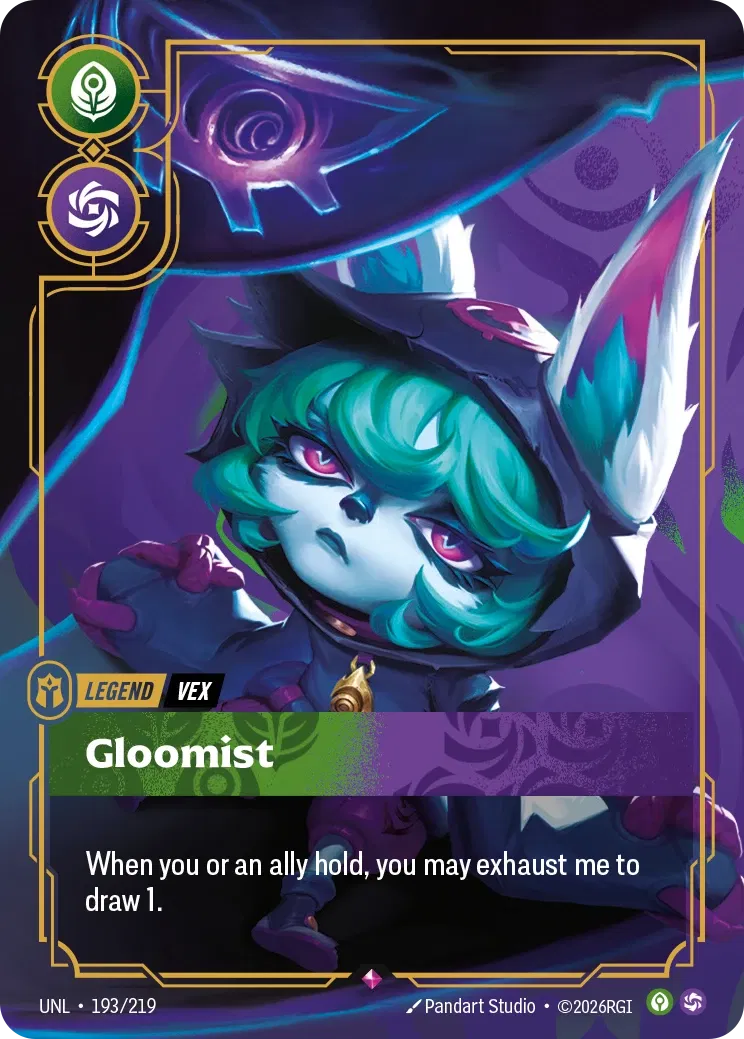
"When you or an ally Hold, you may exhaust me to draw 1." Every battlefield you sit on, uncontested, turns into a card. The more ground you hold, the fatter your hand — so being patient isn't passive, it's your draw engine. This is why Vex wants stalemates that other decks fear.
Relative tendencies, not card stats. Vex trades raw power for card advantage and disruption.
The deck ships several Vex champion units; the signature pick is Vex, Apathetic: "When your opponent plays a unit while Vex, Apathetic is on the battlefield, that unit enters Stunned." Read what that does to a turn — your opponent spends Runes to deploy a fighter, and it arrives unable to deal damage. Do they commit it anyway and eat the tempo loss, or hold it back and cede the battlefield? Every deployment becomes a bad choice. That's the whole Vex thesis in one card: make the opponent's good plays feel awful.
| Vex, Apathetic | The control centerpiece — stuns enemy units that enter her battlefield. Park her on a contested point and the opponent can't profitably attack into it. |
| Vex, Cheerless | Alternative Chosen Champion for a grindier, more value-leaning build. |
| Vex, Mocking ×2 | Cheaper, more disposable Vex bodies — flexible early picks depending on the matchup you expect. |
The complete out-of-the-box list. Tap any card to read its role in the gameplan. The deck leans on cheap, sticky Calm units to plant a flag, and Chaos disruption to keep the opponent off-balance while Vex draws you toward your answers.
Land an early Calm unit that's hard to shift, hold a battlefield, and exhaust Vex to draw. Use bounce (Back Off), stun, and removal (Existential Dread) to deny the opponent a profitable attack into you. Every turn you stall, your hand grows and theirs shrinks. Eventually you're holding twice their cards, and you close the game on a Hold — which, by the Final Point rule, can win you the game from a single battlefield.
Re-read the Final Point rule from the Riftbound tab: a Conquer for your 8th point requires taking both battlefields that turn, but a Hold wins from one. Vex is built to grind to 7 and then simply refuse to be moved off one battlefield through the opponent's entire turn. You don't need a big swing — you need a wall and one more upkeep. Vex, Apathetic plus a Tank/Shield body is exactly that wall.
| Core hold line | Deploy a 4-Might Calm unit at a battlefield → it survives the turn → at your Beginning Phase you Hold (score +1) and may exhaust Vex to draw. Repeat. The opponent must over-commit to break it, walking into your removal. |
| Apathetic lock | With Vex, Apathetic holding a point, any unit the opponent plays there enters Stunned — so their reinforcement deals no damage the turn it arrives, and your defenders win the exchange. |
| Bounce tempo | Back Off sends an attacker back to hand/base, erasing the Runes they spent and resetting the showdown math in your favor. Cheap, repeatable, infuriating. |
| Draw-to-answers | Vex's draw engine isn't card advantage for its own sake — it's how a toolbox deck finds the specific answer (stun, removal, bounce) for whatever the opponent is doing. |
Both Calm and Chaos have superb support and disruption but lack raw Might to muscle through a board. Against a faster, wider deck (Jinx, for instance) the danger is being tempo'd out before your card advantage matters — you take early points and never stabilize. The skill ceiling is real: knowing when to hold and when to push only comes with reps, which is why Vex is a great second deck rather than a first.
| Primary — Hold to 8 | Grind incremental Hold points and close from one fortress battlefield. This is the deck's bread and butter. |
| Attrition | Out-resource the opponent until they have no threats left, then take uncontested points at will. Vex's draw makes you the last deck standing. |
| The Apathetic fortress | A point the opponent literally cannot profitably attack into (stun + bounce + removal) becomes a permanent point engine. |
| Weak into | Fast, wide aggro (Jinx) that banks early points before your engine compounds — you get tempo'd out. Also reach/burn that kills your holders from afar without entering the stun zone, and single giant threats you can't repeatedly bounce. |
| Strong into | Grindy midrange that wants to trade evenly — you out-value them. And anything that relies on profitable one-unit attacks, which the stun-and-bounce package simply switches off. |
Riftbound's premier aggro deck — Vex's mirror in every dimension. Where Vex hoards, Jinx spends: cards, Runes, board, all thrown downrange as fast as possible. A low Fury/Chaos curve that turns discarding your own hand into tempo, races onto battlefields, and tries to close before control can set up.
"Blow it all up!" Jinx is the opposite philosophy in every dimension. Where Vex hoards, Jinx spends — cards, Runes, board presence, all thrown at the opponent as fast as possible. This is Riftbound's premier aggro deck: a low curve of explosive units and damage spells that converts discarding your own hand into a tempo advantage, races onto battlefields, and tries to close the game before a control deck can set up. If you've ever wanted to play a champion whose downside is also her engine, this is it.
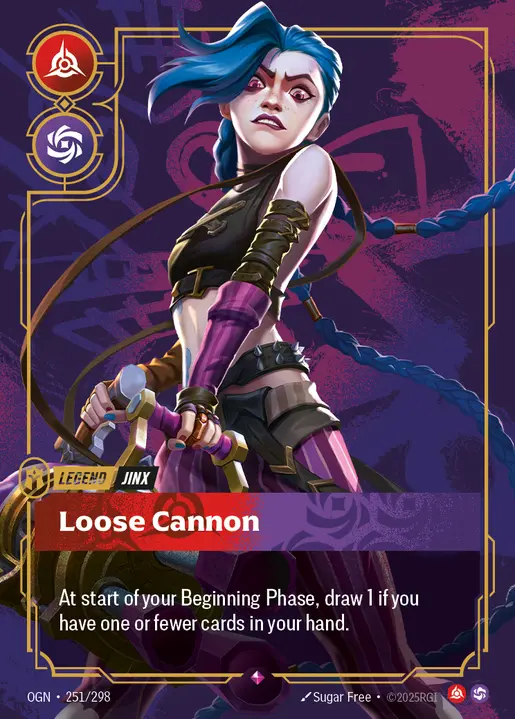
"At the start of your Beginning Phase, if you have 1 or fewer cards in hand, draw a card." The whole deck is built to dump its hand fast — and Loose Cannon rewards an empty hand with refills. You're meant to be running on fumes; that's when she's strongest. Discard is fuel, not a cost.
Relative tendencies. Jinx maxes aggression and tempo; her card advantage is "refill from empty," not "go wide on cards."
A 3-cost, 4-Might champion with Assault 2 — but you pay to play her by discarding 2 cards. In this deck, that's barely a cost: half your discards want to be in the trash. The kicker is her Accelerate: pay one extra Energy and recycle a Fury Rune, and she enters ready, swinging immediately for 6 (4 + Assault 2) to conquer a battlefield the turn she lands. Hold her until there's a unit worth killing or a point worth taking, then drop the hammer.
Get Excited! discards a card to deal that card's Energy cost in damage to a unit. So your expensive, clunky cards become precision removal. Pick what to pitch and a target's Might — see if it dies.
A deliberately low curve — the deck wants to be doing something every turn from turn one and to have dumped its hand by the mid-game. Tap any card for its role. The curve chart shows just how front-loaded it is.
Curve out cheap aggressive units, push onto battlefields early, and use discard as both fuel and removal. Assault units (Chemtech Enforcer, Raging Soul) hit harder on the attack, so you're always the one initiating. Get Excited! and Void Seeker clear blockers so your swings connect. Take points fast, keep the pressure relentless, and refill an empty hand with Loose Cannon. You're trying to be at 6–7 points before the opponent has stabilized.
| Discard, profitably | Pitch Scrapheap (draw a card when discarded) and Flame Chompers (can be cheated into play from the discard) — you lose nothing and develop a threat. Discard is a resource, not a tax. |
| Discard as a kill spell | Get Excited! + a fat card (Magma Wurm at 8, Undercover Agent at 5) = a big, cheap removal blast. The clunkiest card in your hand becomes a guided missile. |
| Accelerate to steal points | Both Jinx, Demolitionist and Blazing Scorcher can enter ready via Accelerate and attack the turn they land — surprise conquers the opponent can't have blocked. |
| Rhasa as a free finisher | Rhasa the Sunderer costs 1 less for each card in your Trash. By the mid-game your aggressive discarding has made a 10-cost, 6-Might body cost almost nothing — a second win condition control can't easily answer. |
| Battlefields that enable | Zaun Warrens (discard → draw) filters toward gas; Targon's Peak readies 2 Runes at end of turn so you can hold up Action spells; Reaver's Row recalls a unit to base to save an Assault threat for another swing. |
Two clocks tick against you. First, your own deck: all this churn means you can Burn Out (reshuffle Trash and hand the opponent a point) if the game goes long — so closing fast isn't a preference, it's a requirement. Second, a control deck that stabilizes: if Vex sets up her wall and starts drawing two cards to your refilled one, your gas runs out and her engine buries you. Jinx must win the early game or she loses the late one.
| Primary — tempo race | Bank early and mid points faster than the opponent can answer, and close by roughly turn 6–8 before slower decks come online. |
| The final point | Hold a battlefield to 8, or commit a huge turn to conquer both battlefields at once for the winning point. |
| Reach + Rhasa | Get Excited! and Void Seeker double as direct removal to clear a final blocker; Rhasa is a cheap late finisher when your Trash is full. |
| Weak into | Control/defense that survives the rush and stabilizes (Vex) — if you don't close by mid-game, their card advantage takes over. Efficient blockers, bounce, and stun (Back Off, Apathetic) reset your tempo and waste your committed Runes. And your own Burn Out: every greedy draw is a future point you may gift away if you deck out. |
| Strong into | Slow, setup-reliant decks that need time to come online — you punish them before they're ready. And single-blocker defenses, which Get Excited! / Void Seeker simply remove before you swing through. |
In Riftbound, Kha'Zix brings the Void's relentless adaptability to a tactical Body and Chaos midrange deck. Rather than relying on the raw strength typical of Body legends, the Voidreaver combines powerful four- and five-cost threats with Hidden, Ambush, and disruptive Chaos effects, forcing opponents to constantly anticipate the next threat. The deck aims to establish early battlefield control and generate experience through cards such as Vex - Apathetic, Mister Root, Forbidding Waste, and Irresistible Faefolk, before transitioning into stronger mid-game units like Rengar - Trophy Hunter. Ambush cards, particularly Nidalee - Cat Form and Kha'Zix - Mutating Horror, allow the deck to reinforce vulnerable units while expanding its board in response to an opponent's actions. Grim Resolve is central to its early development, while Void Assault, Punch First, and inexpensive disruption help preserve an advantage once Kha'Zix takes the lead. Competitively, the legend showed promise early in the Unleashed set, earning two Top 16 and two Top 32 regional finishes, as well as four Top 8 appearances in tournaments with at least 64 players. However, its results declined later in the season, as the deck often developed too slowly against Aurora and Annie strategies or lacked the sustained value needed to overcome Azir.
Coming soon. This deck study is being written. Check back shortly — change is good.
Coming soon.
Coming soon.
Fourteen questions drawn from every corner of the guide — the premise, the board, turns, combat, the rules layers, and the deck studies. One correct answer each; the explanation appears the moment you click.
One correct answer each. Click an option to reveal the explanation. Your score updates live at the bottom.